


Think you know your EVP? The web has already put it to the test
You can say your company offers growth opportunities, a strong feedback culture and empowering, partnership-based leadership. You can have a well-designed careers page, a consistent employer branding campaign and compelling recruitment content.
The problem starts when a candidate checks what the internet has to say about those claims – and finds a very different story.
Today, EVP no longer exists solely as a message controlled by the employer. Candidates can compare it with employee reviews, forum discussions and social media conversations. Increasingly, they can also ask AI models such as ChatGPT, Gemini, Claude or Perplexity what it is actually like to work for a particular organisation.
This means a new verification point has entered the candidate journey: what does AI say?

From employer claims to external validation: how does AI see your EVP?
Employer reputation is now shaped within a much broader ecosystem than the careers page alone. Researchers have been showing for years that organisational reputation is co-created through a network of interactions between the company, employees, audiences and the media, rather than being determined solely by the brand’s own communications.
See the study “Social Media and the Formation of Organizational Reputation”.
Generative AI adds another layer to this ecosystem. These systems can bring together information from multiple public sources and synthesise it into a single response. Candidates no longer need to browse through dozens of search results themselves in order to ask: “What is the workplace culture like at company X?” or “What are the most common pros and cons of working for this organisation?”. The careers page still matters, but it has become just one part of a much larger information environment.
That leads to an important question: If a candidate never saw our careers page, would they reach similar conclusions about our company based on the open web and AI-generated answers?
When reputation starts telling a different story
Marta Quarta from Randstad Advisory describes the difference between a communicated Employer Value Proposition and the picture emerging from a company’s digital footprint as a signal gap. See the Randstad Advisory article.
The principle is simple. A company communicates: “We provide genuine opportunities for growth”, yet employee reviews repeatedly mention a lack of promotions and unclear career paths. Or it claims to have “a culture of open feedback”, while candidates describe, for example, receiving no feedback after recruitment processes. These discrepancies create an information gap.
Not every negative review is a problem. What matters far more is a recurring pattern – a situation in which multiple sources consistently tell a different story about the company than its own EVP does. The real issue is the lack of alignment between what the company promises and what its digital footprint actually validates.
What does AI see beyond the company website?
A 2026 study by Dmitrij Zatuchin analysed more than 167,000 citations relating to 128 brands. In the dataset, 85.7% of citations used by AI systems pointed to third-party sources, while only 14.3% linked to channels owned by the brands themselves. See the study.
This does not mean that exactly the same ratio will apply to every employer. It does, however, highlight something much more important: the way a brand is represented in generative systems may depend heavily on information over which the company has no direct control. This is why employer branding should be analysed across three levels:
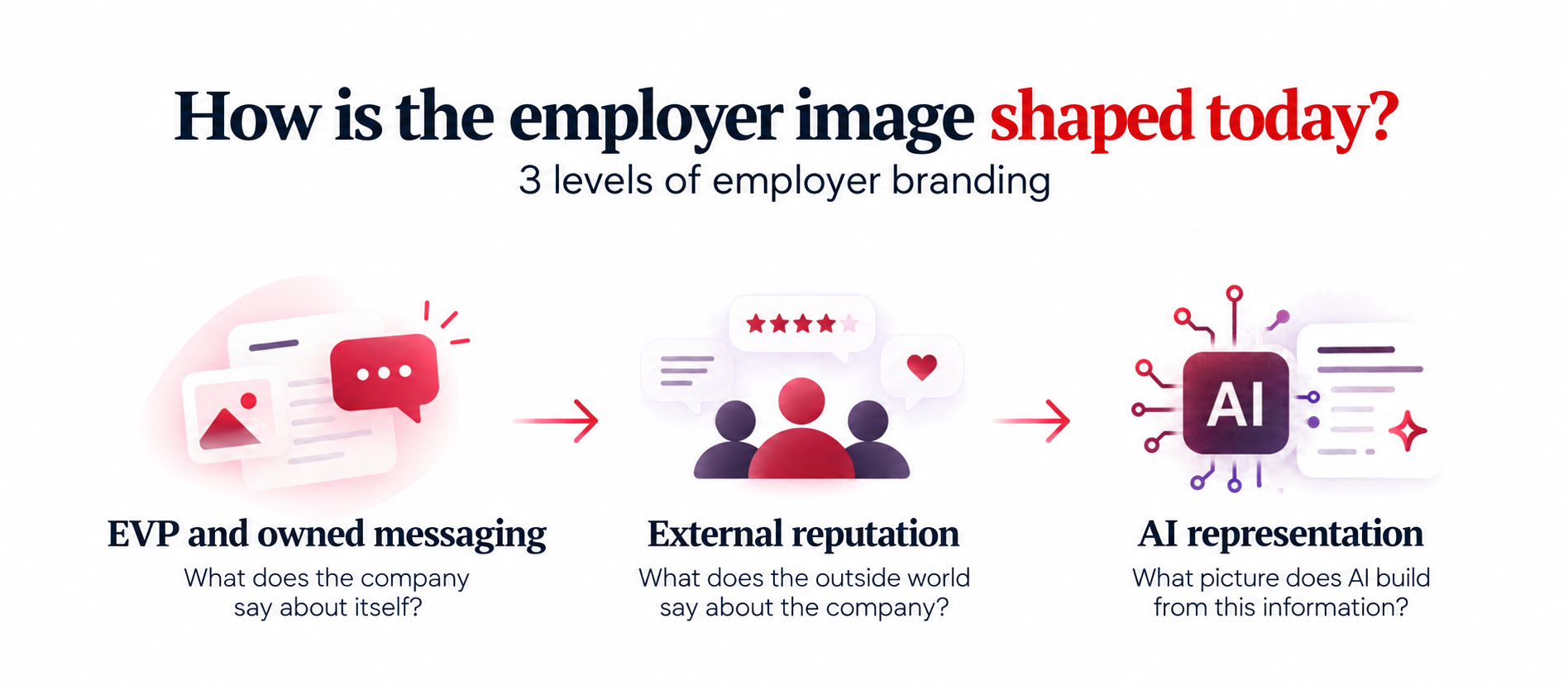
It is the differences between these layers that reveal where the employer brand is aligned and where a disconnect appears. Such a gap does not have to become a permanent problem. It can be identified, the sources of inconsistency can be mapped, and actions can be planned to bring the declared employer promise closer to how the company is represented across the open web and in AI-generated answers.
A well-managed EVP should leave evidence behind
If development is one of the organisation’s core employer promises, there should be stories, data and employee experiences online that demonstrate it. If the company claims to have a feedback culture, that should be visible not only in a headline on the careers page, but also in the candidate experience, employee reviews and the way the organisation responds to criticism.
The same applies to internal communication. What the company promises externally should be rooted in the actual employee experience. If internal communication is inconsistent, lacks credibility or fails to keep up with organisational change, sooner or later this may also be reflected in the company’s external reputation. Read more about how we design internal communication systems at LoveJob.
The point is not to create more claims. It is to create more credible evidence to substantiate those claims.
The company’s response is also a signal
It is also worth looking at review management differently. A study by Höllig, Ademi and Tumasjan, covering almost 300,000 reviews of more than 21,000 employers, found that when organisations began responding to reviews, subsequent reviews changed in character — they became more detailed and more informative. See the study.
An employer response is therefore not merely a PR reaction. It becomes another public signal showing how the organisation behaves in response to feedback and criticism. If a company claims to value openness and dialogue but publicly ignores questions or difficult reviews, that too communicates something about its culture and, in a way, contradicts its own claims – even if unintentionally.
Checking one prompt is not enough
AI is not a neutral mirror of the Internet, and model responses are not fully deterministic, meaning that similar questions can produce slightly different answers. Outcomes can be influenced by factors such as how the question is phrased, which sources are available, the order in which information is presented or the model itself.
For that reason, an audit of brand representation in AI should not consist of typing a single question into ChatGPT and taking a screenshot. What is far more revealing is a recurring pattern: asking similar questions across several tools, analysing the sources used and comparing the responses with what the organisation actually communicates.
This is where it becomes possible to determine whether the issue lies in communication, reputation, a lack of supporting evidence or information online that is simply outdated.

Before launching the next employer branding campaign
It is worth starting by looking at the employer brand from the perspective of someone who does not begin their journey on the “Careers” page.
Instead, they begin with questions such as: What will they see in search results? Which themes keep appearing on employer review platforms? How is the company portrayed in discussions and articles? And what will they get when they ask AI tools about the organisation?
Only by comparing this information with the EVP can you see which parts of the employer promise are strongly validated, which remain almost invisible and which collide with a different narrative across the open web.
And this is where the next stage of employer branding work should begin today.
If you want to understand where your declared EVP ends and the real picture of your employer brand across the web and AI begins, let’s talk. You can use our Contact Form or email us directly at office@lovejob.pl.